
Everything you need to know before ordering custom equipment nameplates in Australia — from material choice to pricing.
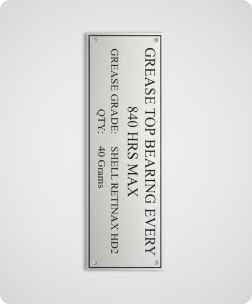
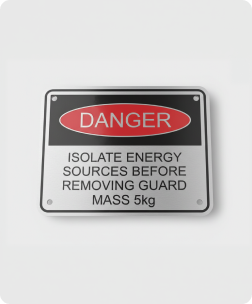
An equipment nameplate is a permanent identification tag fixed to machinery, appliances, vehicles, or industrial assets. It typically carries manufacturer details, model and serial numbers, electrical or mechanical ratings, compliance markings, and sometimes branding. Unlike a printed sticker, a nameplate is built to stay legible and attached for the working life of the equipment — which is why material choice matters so much more here than for general labelling.
Searching for an “equipment nameplates template” usually means one of two things: a design layout to visualise what information goes where, or a print-your-own template for basic indoor labelling.
Templates are useful for:
Templates fall short when equipment nameplates need precise cut-outs for mounting holes, curved or irregular surfaces, or a material rated for outdoor/industrial exposure. At that point, a custom-fabricated plate — sized and drilled to your equipment’s exact mounting pattern — replaces the DIY template approach.
Plastic nameplates (typically laminate materials, engraved to reveal a contrasting core colour) are a common choice when:
Engraved plastic won’t corrode and resists most indoor chemicals and light abrasion, but it’s more vulnerable than metal to UV degradation, high heat, and heavy outdoor weathering. For equipment that lives outside, near chemical processing, or in direct sun long-term, stainless steel or anodised aluminium will outlast plastic significantly.
| Factor | Engraved Plastic | Metal (Stainless Steel / Aluminium) |
| Best for | Indoor equipment, control panels, budget runs | Outdoor, harsh, or long-life industrial equipment |
| UV/weather resistance | Moderate | High |
| Chemical/abrasion resistance | Moderate | High |
| Typical lifespan | 3–7 years indoors | 10+ years, even outdoors |
| Relative cost | Lower | Higher upfront, lower lifetime cost |
Australian conditions push nameplate materials harder than most markets — intense UV exposure, coastal salt corrosion, and wide temperature swings across states. Nameplates sourced for outdoor, marine, mining, or agricultural equipment in Australia generally need higher-grade materials (marine-grade or 316 stainless steel, UV-stable printing) than equivalent equipment used indoors or in milder climates. It’s also worth checking local compliance requirements — some equipment categories require specific ratings or certification markings to be legible for the product’s service life, not just at installation.
Cost depends on three main factors:
As a rough guide, small custom runs can range from a few dollars per plate for basic plastic tags up to $20–$30+ per plate for small batches of engraved stainless steel with complex artwork. Getting an exact quote requires specifying material, size, quantity, and marking method — costs vary too much by supplier and spec to give a single reliable number.
As a starting checklist:
For a full breakdown of sizes, materials, and finishes suited to Australian industrial conditions, see our industrial nameplates guide.
What is the best material for outdoor equipment nameplates?
Stainless steel and anodised aluminium hold up best against UV, moisture, and corrosion in outdoor Australian conditions.
Can I use a template to design my own equipment nameplate?
Yes, for layout planning or low-exposure indoor use. For precise mounting holes, curved surfaces, or industrial-grade durability, a custom-fabricated plate is more reliable.
Are plastic nameplates durable enough for machinery?
Engraved plastic works well for indoor machinery and control panels but degrades faster than metal under UV, heat, or heavy chemical exposure.
How much do custom equipment nameplates cost?
Cost depends on material, marking method, and order volume — expect a few dollars per plate for basic plastic tags up and $20-$30+ for small batches of engraved stainless steel.