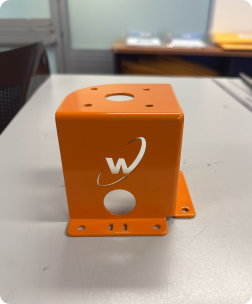
A custom steel bracket is cut, bent and finished to your drawing, so it fits the job for the first time. To get the right one, you need to settle five things: the load it carries, the material, the shape, the finish and the fixing points. This guide covers all five, with a focus on trailer and industrial applications.
Custom steel brackets are fabricated supports made to your dimensions instead of picked from a catalogue. They hold, connect or mount components such as trailer fittings, equipment, shelving, pipework, panels and machinery.
Off-the-shelf brackets work for simple jobs. Custom brackets make sense when the hole spacing is non-standard, the load is high, the space is tight, or you need the same part repeated across a run.
| Material | Best for | Notes |
| Mild steel | General structural use, indoor or coated | Strong and economical, but needs a finish to resist rust |
| Galvanised steel | Outdoor and trailer use | Good corrosion protection at a moderate cost |
| Stainless steel (304 / 316) | Wet, coastal, food or chemical environments | Highest corrosion resistance. 316 is better near salt water |
| Aluminium | Weight-sensitive applications | Light and corrosion resistant, but not as strong as steel |
For trailers that see rain, mud, road salt or boat ramps, galvanised or stainless steel will outlast bare mild steel by years.
Laser cutting and CNC bending are what make repeat orders match, which is important if you’re fitting out several trailers or machines.
Trailer brackets face constant vibration, so design details matter:
If you’re after custom steel brackets for trailers in Melbourne or anywhere else in Australia, send us your drawing or a photo with measurements and we’ll advise on the best material and finish. (Only keep the Melbourne mention if you service or ship there.)
The more detail you provide, the faster and more accurate the quote.
What’s the difference between custom brackets and standard brackets?
Standard brackets come in fixed sizes. Custom brackets are made to your exact dimensions, material and finish.
What thickness of steel should I use for a bracket?
It depends on the load, the span and whether there’s vibration. Thin material suits light mounting, while structural or trailer use usually needs thicker plate or gussets. We can recommend a thickness if you share the application.