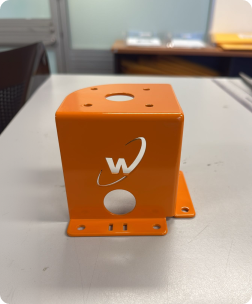
The right bracket material depends on what it has to survive, not just what it has to hold. Stainless steel (316/304) is the default for corrosive, marine, or wash-down environments. Galvanised or powder-coated steel suits general outdoor and industrial use where budget matters more than maximum corrosion resistance. Aluminium alloys are the lightweight option for equipment where weight or non-magnetic properties matter. UV-stable engineering plastics work where electrical isolation or chemical resistance outweighs load-bearing strength. Get the material wrong and you’re looking at rust, fatigue cracking, or a bracket that fails years before the equipment it’s holding.
A bracket is a small, unglamorous part of a much bigger installation — which is exactly why it gets overlooked until it fails. A mounting bracket holding a sensor on a mining site, an antenna plate on a telecom tower, or an inverter bracket on a solar farm is expected to outlast the equipment it supports, often in conditions far harsher than the equipment itself was designed for. The right material isn’t the strongest one on paper; it’s the one specified for the exact combination of load, exposure, and lifespan the site demands.
Stainless steel is the standard choice when a bracket needs to survive moisture, salt air, or regular wash-down without degrading. Grade 316 contains molybdenum, which gives it stronger resistance to chloride pitting than 304 — making it the better pick for coastal sites, marine environments, and food or chemical processing areas where equipment is hosed down regularly. Grade 304 is a step down in cost and still performs well for general outdoor and indoor industrial use where salt exposure isn’t a daily factor.
Typical fit: coastal solar installations, marine equipment mounts, food and beverage facilities, wastewater treatment sites.
Where budget is a bigger constraint than maximum corrosion resistance, galvanised or powder-coated mild steel is often the more practical option. Hot-dip galvanising forms a zinc coating that protects the steel from rust for years in general outdoor conditions, while powder coating adds a durable, customisable finish suited to less aggressive environments. Neither matches stainless steel for long-term corrosion resistance in high-salt or constant-moisture settings, but for inland industrial sites, warehousing, and general infrastructure, it’s a cost-effective middle ground.
Typical fit: warehousing, general manufacturing, inland infrastructure, utility brackets and pole clamps.
Aluminium brackets matter most where weight is a real constraint — rooftop solar mounting, telecommunications equipment on towers, or any installation where reducing structural load matters. Aluminium also doesn’t rust the way steel does, and its natural oxide layer gives it reasonable corrosion resistance on its own. It’s a common choice where non-magnetic properties are required around sensitive instrumentation, and where the bracket needs to be strong enough for the job without adding significant weight to the structure it’s mounted on.
Typical fit: rooftop and rail-mounted solar panels, telecommunications towers, instrumentation near magnetically sensitive equipment.
Plastic brackets aren’t the default, but they solve a specific problem metal can’t: electrical isolation. Where a bracket needs to prevent electrical conductivity — near control panels, sensors, or wiring — UV-stable engineering plastics hold up to prolonged sun exposure without becoming brittle, while avoiding the conductivity and galvanic corrosion risks that come with metal-on-metal or metal-on-dissimilar-metal contact. They’re not a like-for-like substitute for structural steel or aluminium brackets, but for lighter-duty, electrically sensitive applications, they’re often the more sensible spec.
Typical fit: control panel mounts, sensor housings, applications requiring electrical isolation.
Material is only half the specification — the finish determines how long that material actually performs in the field:
| Environment | Recommended Material |
| Coastal / marine / wash-down | Stainless steel 316 |
| General outdoor / industrial | Stainless steel 304 or galvanised steel |
| Budget-conscious inland infrastructure | Galvanised or powder-coated steel |
| Weight-sensitive or rooftop installations | Aluminium alloy |
| Electrically sensitive or isolation-critical | UV-stable engineering plastic |
Because brackets are custom-fabricated rather than off-the-shelf, material selection is usually the first conversation, not an afterthought. We work from your CAD file, drawing, or an on-site description of the environment to recommend the material and finish combination suited to the load, exposure, and lifespan you need — and fabricate it in-house via laser cutting, press-brake forming, CNC machining, or folding to your exact dimensions.
If you’re specifying brackets for a solar farm, telecommunications site, mining operation, or general industrial facility, our custom brackets page covers material options, typical applications, and lead times in full. For larger fabrication requirements beyond brackets, see our stainless steel fabrication service.